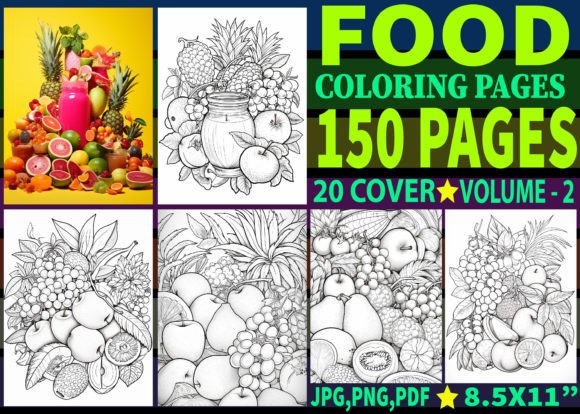
150 Foods Coloring Pages for Adults
Coloring isn’t just for kids—and it’s far more than a nostalgic pastime. For adults, it’s a focused, tactile way to reset attention, explore visual language, and reclaim creative agency without pressure to “make art.” 150 Foods Coloring Pages for Adults meets that need with precision: 300 DPI black-and-white line art—thoughtfully drawn, consistently sized (A4 / 8.5×11″), and delivered in three versatile formats: PDF, JPG, and PNG. Whether you’re designing a print-ready KDP interior or building digital assets for teaching, branding, or client work, this collection gives you clean, scalable raw material—not filler.
Why Food? Why Now?
Foods carry immediate recognition, cultural resonance, and emotional texture. A single illustration of a ripe mango, a rustic sourdough loaf, or a steaming ramen bowl triggers memory, context, and sensory association—making them ideal anchors for creative projects. Unlike abstract patterns or generic florals, food subjects invite narrative: seasonality, origin, preparation, celebration, sustainability. That depth makes them unusually flexible across audiences—from mindfulness practitioners seeking grounding imagery to food bloggers illustrating seasonal recipes or educators building nutrition literacy tools.
Real-World Applications—Beyond the Page
This isn’t a static coloring book. It’s a toolkit. Here’s how different users are already applying it:
- Self-publishers & KDP creators: Use the 150-page PDF as-is for a no-edit launch—or mix and match JPGs and PNGs to build themed volumes (e.g., “Farm-to-Table,” “Global Street Food,” “Plant-Based Staples”). The consistent 300 DPI ensures crisp printing at scale, and the A4 sizing aligns with Amazon’s KDP requirements without cropping or scaling guesswork.
- Educators & wellness coaches: Print individual pages for group workshops on mindful eating, food literacy, or stress reduction. Pair a coloring session with short prompts (“What memories does this dish evoke?” or “Where might this ingredient grow?”) to deepen engagement without requiring artistic skill.
- Designers & marketers: Extract PNGs with transparent backgrounds to layer over product photos, social posts, or email headers. Add subtle halftone textures, duotone overlays, or hand-lettered captions—then repurpose across Instagram carousels, Pinterest pins, or printable recipe cards.
- Small business owners (cafés, farms, meal kits): License or adapt pages for branded takeaways—coloring sheets included with orders, in-store activity kits, or loyalty program bonuses. A custom-colored “local heirloom tomato” page becomes both a marketing touchpoint and a conversation starter.
Volume 2 Adds Dimension—Not Just Quantity
The companion set—150 Foods Coloring Pages for Adults Volume 2—isn’t repetition. It expands stylistic range: tighter linework for fine-detail colorists, bolder silhouettes for beginners or large-format printing, and intentional negative space for collage or mixed-media integration. Together, the two volumes offer contrast in rhythm and density—letting you curate flow intentionally. Want a calming progression? Start Volume 1 with soft botanicals (herbs, citrus), shift into Volume 2’s structured grain bowls and layered pastries, then close with shared-meal scenes (communal tables, market stalls). That kind of sequencing matters when readers turn pages—it supports immersion.
Designing Your Own Interior? Keep These Practical Principles in Mind
You’re not just assembling pages—you’re shaping an experience. Clarity and consistency start with format discipline:
- Stick to one base size. All files are A4 / 8.5×11″ at 300 DPI—so avoid resizing mid-project. If you need thumbnails or web previews, generate those from the originals, not intermediate edits.
- Test contrast early. Open a few JPGs in your layout software and check line weight against your chosen paper type (e.g., matte vs. glossy). Thin lines may disappear on low-ink settings; adjust stroke width in editing if needed—but only after verifying output on a physical proof.
- Group by function, not just subject. Don’t cluster all “fruits” together. Instead, consider pacing: alternate intricate pages (avocado cross-sections, layered lasagna) with open-composition ones (a single olive branch, a minimalist coffee cup) to prevent visual fatigue.
- Leverage transparency smartly. PNGs let you overlay food illustrations onto gradients, textures, or photos. Try placing a chili pepper outline over a terracotta background for a warm, earthy cover variation—or drop a sushi roll onto a navy gradient for contrast and sophistication.
Your Book Cover Starts Here—Not Later
The included 20 KDP-ready cover PNGs (also 300 DPI) aren’t templates to be used as-is—they’re springboards. Resize freely, but preserve aspect ratios. Layer two food elements (e.g., a wheat stalk + mortar & pestle) to imply craft and origin. Add minimal typography in a legible, high-contrast font—avoid script fonts smaller than 24pt on covers. Remember: your cover must communicate genre at thumbnail size. “Food coloring book for adults” should be instantly legible—even on a phone screen scrolling through Kindle categories.
Originality Isn’t About Drawing From Scratch
Using pre-drawn pages doesn’t dilute originality—it redirects your energy. Instead of drafting every outline, you invest time in curation, sequencing, contextualization, and audience alignment. A teacher adapting these for a middle-school nutrition unit adds discussion questions and local food maps. A designer building a brand kit swaps out default colors for a client’s palette and integrates their logo subtly into corner flourishes. An entrepreneur bundles printed sheets with locally roasted coffee beans and a tasting guide. In each case, the value isn’t in the line art alone—it’s in how thoughtfully it’s applied.
Ready When You Are
The .zip file delivers everything in production-ready form: no watermarks, no licensing friction, no pixelated surprises. What you do with it reflects your voice, your audience, and your goals—not the limitations of the source files. So whether you’re launching your first KDP title this month, prototyping a workshop series next quarter, or refreshing your brand’s visual library before a product launch—150 Foods Coloring Pages for Adults is infrastructure you can trust. Not inspiration you wait for. Infrastructure you build on.