Steampunk Car Coloring Pages
If you’ve ever flipped through a vintage engineering manual, admired brass-and-gear clockwork sculptures, or paused mid-scroll at a retro-futuristic car concept—then Steampunk Car Coloring Pages isn’t just another download. It’s a ready-to-deploy creative asset built for real-world use: from Amazon KDP interiors to print-on-demand stationery, classroom enrichment tools, and even custom merch for niche hobbyist communities.
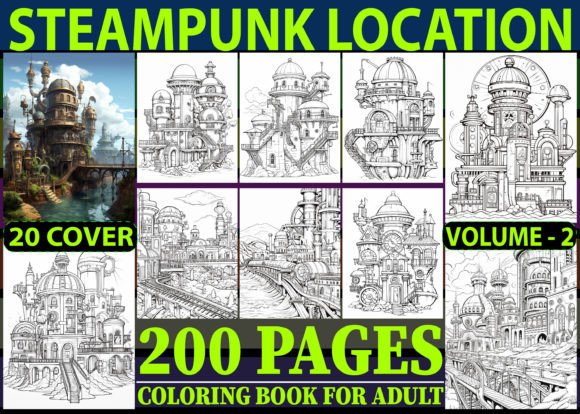
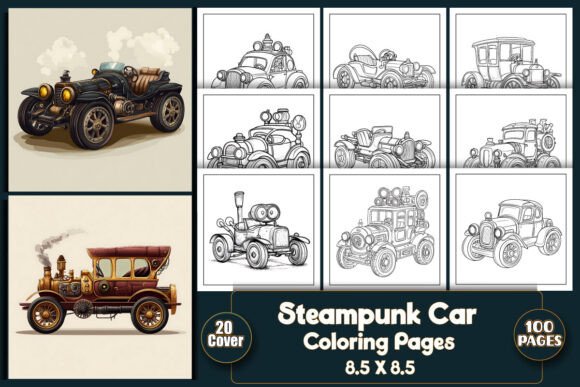
These aren’t generic line drawings. Each of the 100 original designs fuses Victorian-era aesthetics with industrial imagination—think exposed pistons, copper piping wrapped around chassis, leather-bound steering wheels, smokestacks sprouting from hoods, and ornate filigree layered over chrome fenders. The result? A cohesive, visually rich collection that feels intentional, not algorithmic—even though they’re AI-generated, the output quality meets professional publishing standards.
Why This Fits Your Workflow—Not Just Your Wishlist
You don’t buy coloring pages to file them away. You buy them because you need something *functional*: a plug-in element for a larger project, a time-saving shortcut in product development, or a reliable visual anchor for an audience that values craftsmanship and narrative depth. Here’s where Steampunk Car Coloring Pages delivers without friction:
- Amazon KDP creators use the 8.5 x 8.5 inch, 300 DPI PDF files as-is for interior layouts—no resizing headaches, no pixelation when printed. The consistent square format works perfectly for activity books, themed journals, or standalone coloring volumes targeting adults who love steampunk fiction, alternate-history games, or mechanical art.
- Print-on-demand sellers pull high-res JPG and PNG files directly into platforms like Printful or Gelato. Need a steampunk car design on a notebook cover, tote bag, or enamel pin? The clean vector-like linework holds up beautifully—even when scaled down to 2 inches wide or enlarged to poster size.
- Educators and librarians print single pages for STEM+Art (STEAM) units on industrial design history, material science, or even early automotive evolution. Students analyze gear ratios in a drawing of a double-cam engine, then color it—making abstract concepts tactile and memorable.
- Freelance designers and marketers drop PNGs with transparent backgrounds into social media posts, email headers, or landing pages for events like Maker Faires, retro-tech conferences, or indie game launches. One designer recently used three pages as animated “reveal” frames in a Kickstarter campaign video—no custom illustration budget required.
What’s Inside—and Why Format Variety Matters
The .zip package includes four clearly labeled folders: PDF, JPG, PNG, and Covers. That structure isn’t just tidy—it reflects how people actually work:
- The PDF folder holds individual, print-ready pages—ideal for KDP uploads or bulk printing at local copy shops. No bleed or margin guesswork; everything’s pre-set to industry specs.
- The JPG folder gives you crisp, RGB-optimized files for web previews, thumbnails, or digital product mockups. Fast loading, universally compatible.
- The PNG folder contains the same 100 images—but with transparent backgrounds. Essential if you’re layering designs over textures, building branded templates in Canva, or creating SVG cut files for Cricut users.
- The Covers folder includes 20 distinct, high-resolution cover options—each styled differently (minimalist typography, full-illustration, distressed paper texture, etc.). You’re not stuck designing one cover and hoping it converts. You test five variations across ads or A/B test listings.
And yes—the complete PDF compendium is included too. That’s your quick-reference guide, your client presentation deck, or your personal swipe file for future projects.
Real Considerations Before You Download
This isn’t magic dust—you still need to think about context. Here’s what seasoned users keep in mind:
- Licensing clarity: These files are royalty-free for commercial use, but they’re not editable source files (e.g., no AI prompts or layered PSDs). If you need to tweak gear placement or add custom text inside the line art, you’ll do that in Illustrator or Affinity Designer—not by editing the original PNG.
- Audience alignment: Steampunk appeals strongly to readers of authors like Cherie Priest or gamers immersed in *BioShock Infinite* or *Dishonored*. If your target buyers skew younger (under 16) or prefer minimalist or nature themes, this collection may sit less naturally in your catalog.
- Production timing: Because all files are print-ready and consistently sized, you can go from download to live KDP listing in under 90 minutes—if you already have your title, description, and keywords drafted. No waiting for revisions or outsourcing formatting.
- AI transparency: While these are AI-generated, the prompt engineering and post-processing resulted in unusually clean, balanced compositions—no floating gears, inconsistent perspective, or clipped details. Still, if your brand positioning emphasizes “hand-drawn exclusivity,” you’ll want to phrase your product description honestly (e.g., “professionally refined AI-generated illustrations”).
Where This Fits in Your Bigger Picture
Think beyond the page count. A set like Steampunk Car Coloring Pages often becomes the foundation for a micro-niche ecosystem: a coloring book leads to a companion journal with matching cover art; those same PNGs become assets for a Patreon tier offering monthly “steampunk vehicle design challenges”; educators build lesson plans around the imagery and license the bundle for school-wide use.
One small press publisher told us they used the covers folder to launch a limited-run chapbook series—each issue featured a different steampunk car as its motif, paired with short fiction from emerging writers. The coloring pages became both promotional collateral and interactive extensions of the stories.
That’s the quiet power here: consistency of theme, reliability of format, and visual cohesion across 100 pieces—so you spend less time curating and more time connecting with the people who’ll actually use, share, or build upon what you offer.
If you’re building something tangible—a book, a product line, a curriculum, a community touchpoint—Steampunk Car Coloring Pages doesn’t ask you to adapt to it. It adapts to how you already work.