100 Bible Coloring Pages for Kids-KDP
For creators, educators, and faith-based entrepreneurs, 100 Bible Coloring Pages for Kids-KDP isn’t just another digital download—it’s a versatile, production-ready asset with measurable strategic utility. When evaluated beyond surface appeal, this collection functions as a foundational tool for building scalable offerings: printable activity books, Sunday school curriculum supplements, branded homeschool resources, or even white-label products for churches and Christian retailers. Its value lies not in novelty alone, but in how deliberately it bridges creative execution with audience need—particularly among families seeking screen-free, scripture-anchored engagement for children ages 3–12.
Strategic Utility Beyond the Page Count
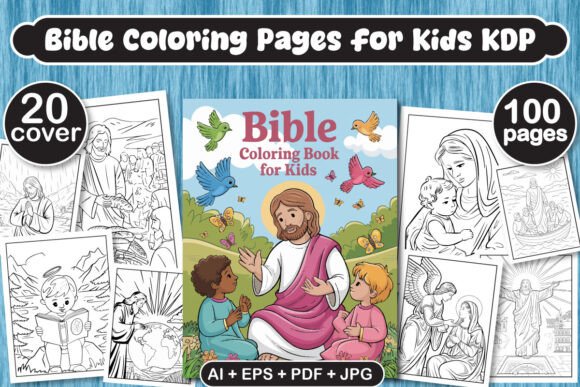
The inclusion of 100 Bible Coloring Pages for Kids-KDP in your content or product pipeline supports several high-leverage objectives simultaneously. First, it accelerates time-to-market: all files are print-ready at 300 DPI in PDF, JPG, EPS, and AI formats—eliminating design bottlenecks for those without illustration expertise or access to designers. Second, it reduces operational friction. With 20 professionally styled cover images included, you avoid costly cover design iterations when launching on Amazon KDP or other platforms. Third, it strengthens positioning: offering a thematically cohesive, doctrinally grounded resource signals intentionality—not just volume—to discerning buyers in the faith-based education space.
This isn’t about filling a catalog. It’s about aligning assets with outcomes. For example, a homeschool co-op leader can integrate select pages into weekly lesson plans—using Noah’s Ark or Daniel in the Lions’ Den to reinforce narrative theology while developing fine motor skills. A small church bookstore manager might bundle printed sets with devotional guides, creating a low-cost, high-perceived-value starter kit for new families. An independent publisher could use the EPS and AI files to adapt line art for custom workbooks—adding discussion questions, memory verse prompts, or parent reflection notes without redrawing core illustrations.
When Context Determines Real Impact
100 Bible Coloring Pages for Kids-KDP delivers strongest returns when deployed within a defined context—not as a standalone “plug-and-play” solution, but as one component of a broader strategy. Random uploads to KDP without differentiation (e.g., no subtitle optimization, no targeted interior enhancements, no clear age-range guidance) risk blending into saturated search results. Conversely, intentional use—such as pairing specific pages with seasonal themes (Advent, Easter, VBS) or aligning with widely taught Bible story curricula (The Gospel Project, Orange, or Answers in Genesis)—creates natural hooks for discoverability and relevance.
Consider planning around outcomes, not output. Ask: What behavior do I want to support? If the goal is increased parental engagement, add simple facilitation notes to the PDF interior (“Ask your child: What did God promise Noah?”). If the aim is classroom scalability, group pages by complexity—early learners (bold outlines, minimal detail), mid-level (moderate detail + scripture references), advanced (scene composition + thematic connections). These decisions transform generic coloring sheets into purpose-built tools.
Practical Integration: From File to Function
Start with file leverage. The inclusion of AI and EPS formats means you’re not locked into static layouts. You can resize elements without quality loss, adjust line weights for younger users, or isolate characters for flashcards or laminated teaching aids. That flexibility supports repurposing across channels: same artwork becomes a printable PDF, a Canva template, a sticker sheet, or even SVG files for Cricut-based craft kits—extending ROI far beyond initial purchase.
Also consider distribution intelligence. While KDP remains the most common launch platform, these files enable multi-channel deployment: sell digital downloads via Gumroad or Payhip with tiered pricing (basic PDF vs. full bundle with covers + editable files); license select pages to Christian app developers for offline activity modules; or offer them as lead magnets—“Download 5 Free Bible Coloring Pages” in exchange for email signups, then nurture with curated lesson ideas and related product offers.
Risks of Undifferentiated Use
Without clarity of purpose, 100 Bible Coloring Pages for Kids-KDP can become an underutilized asset—or worse, a reputational liability. Generic interiors lacking educational scaffolding (e.g., no scripture references, no story summaries, no age guidance) may disappoint educators seeking pedagogical alignment. Similarly, using all 20 cover images without brand consistency (fonts, color palettes, tone) dilutes recognition and weakens trust. One poorly positioned listing—say, targeting toddlers with intricate line work meant for older children—can generate negative reviews that hurt visibility across your entire KDP catalog.
Another subtle risk: over-reliance on quantity over curation. Publishing all 100 pages in one book without grouping logic (chronological, thematic, or developmental) makes navigation difficult for end users. A better approach? Launch multiple focused titles: 10 Bible Stories for Preschoolers, 20 Psalms-Based Coloring Pages, 30 Parables Illustrated for Ages 6–9. Each serves a distinct search intent, improves keyword targeting, and allows for iterative testing of messaging and design preferences.
Long-Term Positioning and Iterative Growth
Treat 100 Bible Coloring Pages for Kids-KDP as a seed—not a finished product. Its real long-term value emerges through layering: adding audio narration links for emerging readers, embedding QR codes that lead to short animated retellings, or integrating with free online resources like BibleProject’s story maps. These enhancements don’t require new illustrations—they deepen utility using existing assets.
From a branding perspective, consistent use of the high-quality cover images builds visual equity. Select one primary cover style and apply it across related offerings—devotionals, memory verse cards, or matching coloring journals. Over time, that cohesion signals reliability to repeat buyers and referral partners alike.
Decision-Making Guidance for Intentional Use
Before deploying 100 Bible Coloring Pages for Kids-KDP, clarify three things:
- Your primary outcome: Is it revenue generation, audience growth, curriculum support, or community building? Each demands different packaging, promotion, and follow-up.
- Your user’s real workflow: Do they print weekly? Bind into notebooks? Use digitally on tablets? Observing actual usage—not assumptions—reveals where to add value (e.g., tablet-optimized PDFs with tap-to-color layers).
- Your capacity for iteration: Can you test variations—different covers, subtitles, or interior enhancements—and measure impact? Even small A/B tests (e.g., “Bible Stories for Little Hands” vs. “Scripture Coloring for Toddlers”) yield actionable insights faster than broad launches.
Finally, remember that fidelity to purpose matters more than speed to market. A single well-positioned, thoughtfully enhanced title built from 100 Bible Coloring Pages for Kids-KDP often outperforms five hastily published versions. The goal isn’t to exhaust the collection—but to extend its reach, relevance, and resonance across audiences who genuinely benefit from it.
Conclusion: Asset, Not Afterthought
100 Bible Coloring Pages for Kids-KDP is most powerful when treated as infrastructure—not inventory. It enables faster prototyping, lowers creative barriers, and supports diversified monetization—all while staying rooted in a mission many buyers actively seek: helping children encounter Scripture in ways that are joyful, memorable, and developmentally appropriate. Your role isn’t just to distribute pages. It’s to shape how those pages function in real homes, classrooms, and ministries—so every line drawn becomes part of something larger than coloring alone.