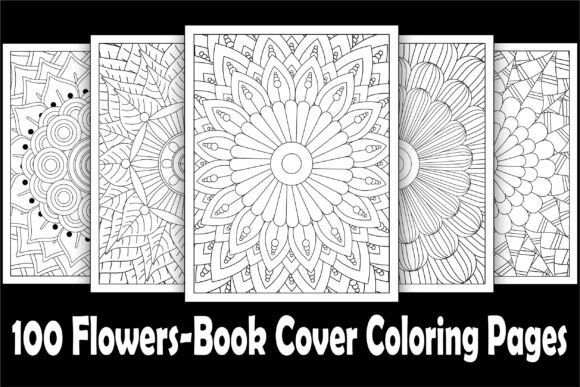
100 Flowers-Book Cover Coloring Pages: A Practical Resource for KDP Creators
For independent authors, designers, and print-on-demand (POD) entrepreneurs building coloring book collections on Amazon KDP, the right interior asset can significantly influence production speed, design flexibility, and market differentiation. The 100 Flowers-Book Cover Coloring Pages is a digital printable bundle explicitly structured to support KDP publishing workflows — not as generic clipart or standalone illustrations, but as functional, production-ready assets tailored for book covers and interiors alike.
What Sets This Bundle Apart From General Flower Coloring Assets
Many flower-themed coloring page collections prioritize artistic variety over technical readiness. The 100 Flowers-Book Cover Coloring Pages diverges by embedding practical publishing requirements into its core design: each of the 100 pages is sized precisely to 8.5″ × 11″ with no bleed, formatted in both high-resolution JPG and print-optimized PDF, and created with clean line work suitable for both cover use and interior coloring. Unlike free or low-cost floral doodle sets that may lack consistent stroke weight, scalable vector clarity, or uniform margins, this bundle delivers standardized files meant to upload directly to KDP without resizing, cropping, or layer adjustments.
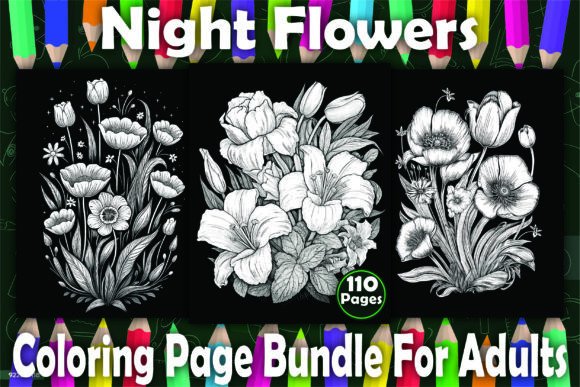
This isn’t just a set of flowers arranged decoratively. Each illustration balances botanical suggestion with stylized simplicity — think outlined blossoms, layered petals, subtle vines, and open negative space — making them adaptable for multiple roles: front cover focal points, back cover accents, interior filler pages, or even section dividers in themed journals or mindfulness books.
How It Fits Into Real KDP Publishing Workflows
KDP creators often juggle three distinct needs: speed of setup, visual cohesion across titles, and compliance with Amazon’s file specifications. The 100 Flowers-Book Cover Coloring Pages addresses all three. Because every file meets KDP’s standard trim size and resolution guidelines, users avoid common upload rejections tied to incorrect dimensions or pixelation. The inclusion of both JPG and PDF formats allows for flexibility — JPGs work well for quick cover mockups or social media previews; PDFs ensure sharp printing for interior pages or layered cover designs in tools like Canva or Adobe InDesign.
Practically, this means an author launching a “Spring Garden Coloring Journal” could select five high-contrast floral pages from the bundle for the cover, then repurpose another 30 as interior coloring content — all while maintaining stylistic continuity. That kind of reuse reduces the need to source disparate assets from multiple vendors or commission custom illustrations for each new title.
Strengths and Situational Fit
The primary strength of the 100 Flowers-Book Cover Coloring Pages lies in its purpose-built utility. It excels when you need:
- Rapid iteration — Launching multiple coloring titles in a short timeframe without redesigning each cover from scratch.
- Consistent branding — Building a recognizable visual language across a series (e.g., seasonal flower themes), where shared line style and scale reinforce collection identity.
- Low-risk testing — Validating demand for floral-themed books before investing in custom cover art or extensive interior illustration.
- Hybrid use cases — Supporting not only full-coloring books but also guided journals, gratitude logs, or therapy workbooks where floral motifs serve as calming visual anchors.
It’s especially effective for creators who already understand KDP’s formatting constraints and prefer working with ready-to-deploy assets rather than raw vectors requiring manual optimization.
Tradeoffs and Limitations to Consider
No single asset bundle serves every need equally. The 100 Flowers-Book Cover Coloring Pages is intentionally focused — which brings advantages, but also boundaries. It does not include editable vector files (e.g., SVG or AI), so users cannot adjust individual petal curves or recolor elements non-destructively. It does not offer alternate versions (e.g., grayscale-only, high-contrast black-and-white, or simplified outlines for younger audiences). And because it’s designed for 8.5″ × 11″, adapting pages for square-format books (like many adult coloring books on KDP) would require intentional cropping — potentially cutting off key design elements.
Additionally, while the floral motifs are varied in composition (roses, daisies, peonies, wildflowers), they follow a cohesive doodle-style aesthetic. That consistency supports branding but may limit appeal for creators seeking maximal stylistic range — say, mixing realistic botanical sketches with abstract ink washes or geometric florals.
When This Bundle Is the Right Choice — And When It Isn’t
This resource fits best for intermediate KDP publishers who value efficiency, have experience uploading to Amazon, and want to expand their catalog with minimal friction. If your goal is to release three new coloring books in the next 60 days — each centered on a different floral theme — and you already have a cover template system in place, the 100 Flowers-Book Cover Coloring Pages streamlines execution without sacrificing visual quality.
Conversely, if your project requires heavy customization — such as integrating text overlays directly into cover art, applying gradient fills to specific petals, or generating animated versions for social promotion — you’ll likely need supplemental tools or services beyond what this bundle provides. Similarly, educators developing classroom materials or therapists designing clinical worksheets may find the lack of labeling, instructional prompts, or developmental scaffolding a limitation.
Another consideration is audience alignment. While floral themes consistently perform well in the adult coloring niche, some segments respond more strongly to specific interpretations — for instance, minimalist line art for urban professionals, or lush, detailed botanicals for horticulture enthusiasts. Reviewing sample pages before purchase helps assess whether the line weight, density, and overall rhythm match your intended reader’s expectations.
Comparing Formats and Usage Scenarios
Most comparable resources fall into one of three categories: royalty-free stock image packs, subscription-based design libraries, or custom illustration commissions. Stock packs often contain isolated flower elements — useful for collage-style covers but less ideal for full-page coloring interiors. Subscription services provide broader variety but introduce recurring costs and licensing complexity around commercial redistribution. Custom commissions deliver exact specifications but require time, budget, and clear creative direction.
The 100 Flowers-Book Cover Coloring Pages occupies a middle ground: one-time acquisition, commercial-use rights included, and immediate usability. Its fixed scope — 100 pages, one size, two formats — makes evaluation straightforward. You know exactly what you’re getting, how it will integrate into existing tools, and how much design time it saves per title launched.
In practice, creators report using this bundle most effectively when combined with a simple workflow: select 3–5 cover-appropriate pages, apply a subtle background tint or texture in Canva or Photoshop, add title typography, then upload the final JPG to KDP. For interiors, they often mix these pages with original line art or licensed patterns to create perceived variety — leveraging the bundle’s reliability while avoiding visual fatigue across 100+ pages.
Making an Informed Decision
Choosing the right coloring page resource depends less on sheer quantity and more on alignment with your production capacity, design goals, and long-term publishing strategy. The 100 Flowers-Book Cover Coloring Pages doesn’t try to be everything — it aims to do one thing well: accelerate the creation of professional, compliant, aesthetically coherent floral-themed books for KDP and POD platforms.
If your priority is reducing technical overhead while retaining creative control over layout and typography, this bundle offers tangible time savings. If instead you’re exploring broader visual directions — say, blending flowers with mandalas, animals, or cultural motifs — you may benefit more from modular illustration sets or hybrid bundles that support compositional layering.
Ultimately, the value of the 100 Flowers-Book Cover Coloring Pages emerges not in isolation, but in context: how it integrates with your tools, supports your timeline, and reinforces the experience you want readers to have — from first glance at the cover to the quiet focus of coloring the final petal.