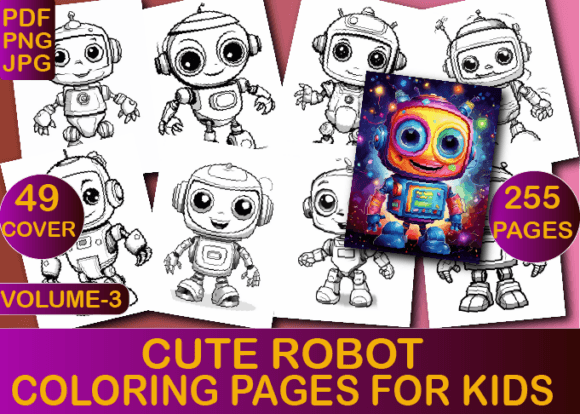
Cute Robot Coloring Book for Kids V-3: A Practical Evaluation for Creators and Educators
For adults designing, publishing, or curating children’s activity resources—especially those working with Kindle Direct Publishing (KDP)—the Cute Robot Coloring Book for Kids V-3 represents a specific, well-defined interior solution. It is not a template generator, an editable design suite, or a subscription-based tool. Rather, it is a ready-to-use, high-resolution interior package intended for immediate integration into a physical or digital coloring book project. Its value lies in consistency, production readiness, and intentional design logic—not novelty or customization flexibility.
What Sets This Interior Apart From Generic Robot-Themed Resources
The Cute Robot Coloring Book for Kids V-3 delivers 255 individual black-and-white line art illustrations—each optimized for coloring by children aged 4–10. Unlike many robot-themed interiors that rely on repetitive geometric patterns or overly technical schematics, this collection emphasizes expressive character design: rounded limbs, friendly facial features, gentle postures, and subtle storytelling cues (e.g., robots holding tools, waving, or interacting with animals or planets). The line weight remains consistent across all images—neither too thin (which risks breakage during printing) nor too thick (which limits fine-motor engagement). This balance supports both crayon and fine-tip marker use without bleeding or visual clutter.
Each illustration is provided as a standalone PNG file, allowing users to rearrange pages, adjust spacing, or repurpose assets outside KDP if needed. The final PDF interior includes bleed margins set precisely for 8.5” x 11” trim size—a detail often overlooked in DIY layouts but critical for avoiding unintended white edges after commercial trimming. That attention to print specifications reflects a focus on real-world production constraints, not just digital aesthetics.
How It Compares With Other Interior Approaches
Many creators begin with royalty-free clipart libraries or AI-generated illustrations. While those options offer scale and speed, they often lack thematic cohesion, age-appropriate simplicity, or print-ready resolution. A set of 255 AI-generated robot images may vary widely in line quality, perspective, and stylistic continuity—making it difficult to maintain a unified visual voice across 50+ pages. In contrast, the Cute Robot Coloring Book for Kids V-3 was developed as a single cohesive series. Every robot shares proportional logic, consistent articulation, and comparable complexity—ensuring predictable difficulty progression for young colorists.
Some designers opt to commission custom illustrations. That route offers full creative control but requires budgeting for illustrator fees (often $500–$2,000+), extended timelines (4–12 weeks), and revision cycles. The Cute Robot Coloring Book for Kids V-3 eliminates those variables. It is a fixed asset: known quantity, known timeline, known output. For creators launching multiple themed books per quarter—or educators building classroom resource kits—the predictability matters more than bespoke uniqueness.
Tradeoffs to Consider Before Use
- No editable source files: The interior is delivered as final PNGs and a flattened PDF. Users cannot modify individual layers, adjust colors pre-output, or tweak vector paths. If your workflow depends on Adobe Illustrator or Affinity Designer edits, this interior will require raster-based adjustments only.
- Thematic specificity: While “cute robot” has broad appeal, it does not substitute for broader categories like “vehicles,” “dinosaurs,” or “ocean life.” If your audience expects genre variety within one book—or if you’re building a series where tone shifts significantly between volumes—this interior commits you to a singular aesthetic lane.
- No instructional or educational scaffolding: Unlike some educational workbooks, this interior contains no prompts, tracing guides, or vocabulary support. It assumes the end user (parent, teacher, or child) will supply context. That makes it highly adaptable—but also places pedagogical responsibility entirely outside the file itself.
When This Interior Fits Well—and When It Doesn’t
The Cute Robot Coloring Book for Kids V-3 serves best when speed, reliability, and visual consistency outweigh the need for granular control. It is particularly suited for:
- KDP publishers launching seasonal or holiday-themed spin-offs (e.g., “Cute Robot Easter Edition” or “Robots in Space Summer Fun”) who want to retain brand recognition while rotating cover designs;
- Teachers creating differentiated classroom handouts—using select PNGs for small-group activities, flashcards, or interactive whiteboard exercises;
- Therapists or occupational practitioners seeking clean, low-stimulus line art to support fine motor development without distracting background elements;
- Small studios producing printed activity packs for local events, maker fairs, or library programs—where fast turnaround and physical durability are priorities.
Conversely, it may fall short for users needing:
- Customizable difficulty levels (e.g., simplified versions for younger children alongside advanced versions for older ones);
- Multilingual labeling or culturally adapted character traits;
- Integration with augmented reality (AR) markers or scannable learning extensions;
- Adaptations for accessibility standards (e.g., high-contrast outlines, tactile embossing guidance, or SVG-based scalable formats).
Practical Integration Notes for Real-World Use
Because the package includes 49 cover backgrounds, users can test visual pairings before committing to a final layout. These are not full cover templates—no title text or spine placeholders are included—but they provide tonal direction (e.g., starfield gradients, circuit-board textures, pastel robot silhouettes) that help align interior and exterior design language. Pairing a soft blue cover background with the lighter-line robots creates a calm, inviting impression; pairing a neon-grid background with bolder robot poses leans into energetic, tech-forward appeal.
One underdiscussed advantage is file organization. All 255 PNGs are named sequentially (robot_001.png through robot_255.png) and grouped logically (e.g., robots with wheels appear early; robots with wings cluster mid-sequence). This allows for quick filtering when building themed sections—“transportation robots,” “friendship robots,” or “space robots”—without manual sorting or renaming.
Also worth noting: the black-and-white format avoids grayscale compression artifacts common in low-bit-depth PDFs. Every line retains crispness even when scaled down for tablet viewing or enlarged for poster printing—making the interior viable beyond standard KDP paperback specs.
Making an Informed Choice
Selecting an interior is rarely about finding the “best” option—it’s about matching capabilities to constraints. The Cute Robot Coloring Book for Kids V-3 excels where consistency, print readiness, and efficient deployment matter most. It is not trying to replace custom illustration, AI tools, or educational frameworks. Instead, it fills a precise niche: a dependable, human-curated, production-tested foundation for robot-themed coloring content.
If your goal is to publish reliably across multiple titles without redesigning fundamentals each time—or if you prioritize clean execution over experimental variation—this interior offers tangible efficiency gains. If, however, your project demands deep personalization, adaptive learning features, or cross-platform functionality, allocating time and budget toward modular or editable alternatives may better serve long-term goals.
Ultimately, the strength of the Cute Robot Coloring Book for Kids V-3 lies in its clarity of purpose. It does one thing well—and does it with attention to the details that affect real-world usability, not just digital convenience.