2025 ADHD Cleaning Planner Canva Kdp: A Flexible, Customizable Tool for Sustainable Home Management
For adults with ADHD, traditional cleaning systems often fall short—not because of effort or intent, but due to mismatched design. Rigid schedules, dense layouts, and static formats can overwhelm working memory, disrupt task initiation, or ignore the need for visual cues, flexibility, and frequent reinforcement. The 2025 ADHD Cleaning Planner Canva Kdp responds directly to those needs by offering a fully editable, visually adaptable planning system built for real-life neurodivergent rhythms.
What Sets the 2025 ADHD Cleaning Planner Canva Kdp Apart
This isn’t a pre-printed notebook or a generic PDF checklist. The 2025 ADHD Cleaning Planner Canva Kdp is delivered as an editable Canva link—meaning every element is adjustable before export. You’re not locked into someone else’s font hierarchy, color scheme, or layout logic. If yellow highlights improve your focus, you can apply them across all checklists. If large checkboxes reduce decision fatigue, you can resize them globally. If a room-by-room breakdown works better than zone-based tracking, you can rearrange sections—or delete what doesn’t serve you.
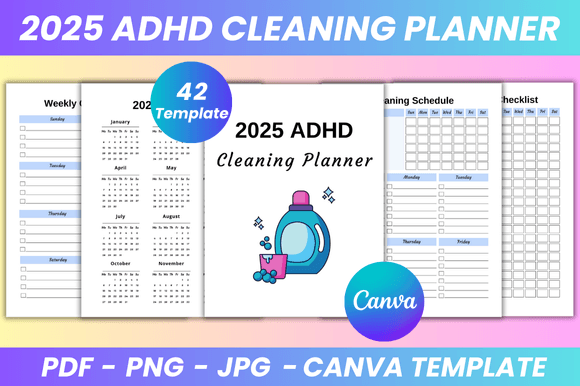
The interior includes over 30 functional pages, each purpose-built: a 2025 yearly calendar with space for recurring reminders; monthly planners that pair deadlines with cleaning priorities; daily and weekly chore charts with built-in speed trackers; and layered checklists (daily, weekly, monthly, yearly) that reflect how often tasks actually need doing—not how often productivity gurus say they should. It also integrates non-cleaning supports like declutter lists, vision boards, and planner notes—recognizing that organization isn’t just about surfaces, but about aligning action with values and energy levels.
How It Compares With Other Planning Approaches
Compared to physical bullet journals, the 2025 ADHD Cleaning Planner Canva Kdp eliminates setup friction. There’s no drawing grids, testing pens, or reworking layouts mid-month. Unlike many digital habit apps—which rely on notifications, streaks, or gamified points—it avoids external dependencies and respects autonomy. You control when and how you engage, without algorithms interpreting “success” as daily logins or perfect completion.
It differs from standard printable planners in its structural intentionality. While many planners offer a single cleaning checklist or a basic monthly grid, this one layers frequency, scope, and context: “Less frequent cleaning tasks” separate deep-cleaning items (e.g., washing windows) from maintenance (e.g., wiping baseboards); “Zone cleaning” and “room-by-room cleaning plan” give options depending on whether you prefer momentum-based sprints or spatial anchoring; and “Speed tracker” helps identify realistic time estimates—not idealized ones—so future planning improves with experience.
When compared to custom-designed Notion templates, the 2025 ADHD Cleaning Planner Canva Kdp trades database functionality for immediacy and visual clarity. Notion excels at linking tasks, automating reminders, and aggregating data—but requires setup time and ongoing maintenance. Canva’s interface is more intuitive for users who prioritize drag-and-drop simplicity over relational logic. And unlike many free Canva templates, this one is specifically structured around ADHD-informed principles: chunked tasks, clear visual hierarchy, minimal cognitive load per page, and repeated access points to key tools (e.g., “Important Notes” appears multiple times—not buried in an appendix).
Strengths and Real-World Fit
The biggest strength of the 2025 ADHD Cleaning Planner Canva Kdp lies in its balance of structure and agency. It provides scaffolding—calendars, checklists, trackers—without enforcing rigidity. For someone who thrives on color-coding, it’s easy to assign hues to categories (blue for bathroom, green for kitchen) and maintain consistency across months. For someone who benefits from photos, adding reference images of “clean vs. cluttered” versions of a drawer or shelf reinforces expectations without lengthy descriptions.
It’s especially well-suited for people who:
- Prefer tangible, print-at-home materials but want the flexibility of digital editing;
- Have tried rigid systems and abandoned them due to inflexibility or burnout;
- Need visual variety to sustain attention (e.g., alternating between checklist-heavy and open-note pages);
- Live with others and want to co-edit or share customized versions (Canva allows collaboration and duplicate links);
- Want to test different strategies—like time-blocking vs. task-batching—without buying new tools.
One practical example: A teacher with ADHD uses the weekly cleaning chart to align chores with her school schedule—moving vacuuming to Sunday afternoons instead of Saturday mornings, then adjusting the entire week’s layout in Canva with two clicks. Another user replaces the default “declutter list” with a photo-based version showing before/after shots of their desk, making progress concrete and reducing reliance on memory.
Tradeoffs and Limitations to Consider
The 2025 ADHD Cleaning Planner Canva Kdp does not include automatic syncing, cloud backups, or voice input. If you rely heavily on mobile access across devices—or need offline functionality without downloading files—it won’t replace a dedicated app. Similarly, while the Canva link is editable, it requires a free Canva account and basic familiarity with the platform. Users completely new to Canva may spend 20–40 minutes learning layout adjustments before printing their first version.
It also assumes a certain level of self-awareness about personal patterns. The planner gives you space to track speed, energy, and mood—but doesn’t interpret that data for you. Someone hoping for AI-generated insights or adaptive suggestions will need supplemental tools. Likewise, while the interior includes “Vision Board” and “My Notes” pages, it doesn’t guide reflection with prompts—those are blank canvases, not guided journals.
Finally, though the PDFs are print-ready at 8.5 × 11 inches, the design prioritizes clarity over compactness. If you prefer pocket-sized portability or want to fit everything into a single spiral-bound book, this may feel oversized compared to minimalist alternatives.
Making the Right Choice for Your Needs
The 2025 ADHD Cleaning Planner Canva Kdp is most valuable when you want control over format *and* function—when “one size fits all” has repeatedly failed you, but starting from scratch feels unsustainable. It’s a middle path: more intentional than a blank notebook, less prescriptive than an app, and more accessible than building a custom dashboard.
It may be less ideal if you strongly prefer analog-only workflows with zero digital steps—or if your main challenge is remembering to *open* the planner at all (in which case, pairing it with a simple phone reminder or sticky-note prompt on your fridge may be necessary). It also doesn’t replace professional support: if executive dysfunction consistently interferes with basic self-care or safety, consulting a therapist or occupational therapist remains essential.
Before deciding, ask yourself:
- Do I benefit from seeing my plan physically—on paper or pinned to a wall?
- Do I frequently adjust how I organize tasks based on energy, time, or environment?
- Am I comfortable spending 15–30 minutes personalizing a tool before using it regularly?
- Do I need reminders, analytics, or integration with other apps—or is simplicity and visual clarity my priority?
If the answer to the first three leans “yes,” and the fourth leans “clarity over connectivity,” the 2025 ADHD Cleaning Planner Canva Kdp offers a rare combination: thoughtful structure, meaningful customization, and respect for how neurodivergent brains plan, initiate, and follow through.