Faith Digital Planner Canva Template
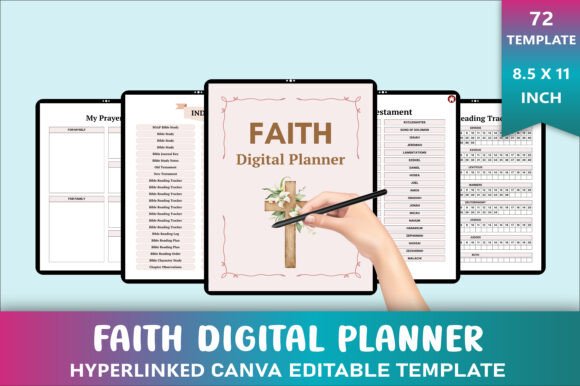
If you’re seeking a tool that blends spiritual intentionality with practical daily planning—without the overwhelm of building from scratch—the Faith Digital Planner Canva Template is a thoughtful, ready-to-use solution. It’s not just another printable PDF or static journal; it’s a fully editable, hyperlinked digital planner designed for believers who want structure without sacrificing personal voice. Whether you're new to Bible study, leading a small group, running a faith-based business, or simply craving consistency in prayer and gratitude, this template meets you where you are—with flexibility, clarity, and quiet reverence.
What People Often Overlook (and Why It Matters)
Many assume any “faith-based” digital planner will do—especially if it looks polished on social media. But appearance alone doesn’t guarantee usability. One common misstep is downloading low-resolution files (like blurry JPGs) expecting crisp printing or smooth scrolling on tablets. The Faith Digital Planner Canva Template avoids this by delivering high-quality JPG, PNG, *and* a hyperlinked PDF—all optimized for both screen use and professional KDP interior formatting. That means your printed version won’t pixelate on Amazon, and your tablet annotations stay legible.
Another frequent oversight? Assuming “editable” means “fully customizable”—only to discover the file opens in a locked PDF viewer or lacks layers in Canva. This template includes a direct, editable Canva link, so you can change fonts, swap background textures, adjust color palettes, insert your own verse graphics, or even restructure entire sections—no design experience needed. You’re not stuck with someone else’s vision; you’re empowered to shape it.
Why “Ready for Home, Office, or Shop Use” Isn’t Just Marketing
This planner works across contexts because it respects how real life unfolds. A small business owner might use the Sermon Notes section to reflect on messages about integrity before client meetings. A homeschool parent could adapt the Bible Reading Tracker into a family challenge. A freelancer may repurpose the Daily Gratitude and Act of Kindness pages as gentle accountability tools during high-stress seasons.
But that versatility only holds up if the structure supports it. Some planners cram too many pages into rigid weekly spreads—leaving no room to breathe or pivot. This one intentionally separates functions: SOAP Bible Study lives apart from Prayer Journal, which is distinct from Gratitude Tracker. You choose what to engage with—and when—without feeling like you’re failing a system.
Avoiding the “Customization Trap”
Here’s a subtle but costly mistake: over-customizing before using the planner meaningfully. We’ve all opened Canva, changed three fonts, added a floral border, then abandoned it—because the joy was in designing, not living. The Faith Digital Planner Canva Template invites intentional simplicity first. Try the default layout for two weeks. Notice which sections you return to (maybe Daily Prayer and Answered Prayer) and which gather dust (Chapter Summaries, perhaps). Then—and only then—edit to match *your* rhythm, not an idealized version of discipline.
Also, avoid importing external fonts without checking licensing. Some free Google Fonts aren’t cleared for commercial use (important if you plan to sell printed versions or offer it as a bonus in your course). This template uses universally safe, web-friendly type pairings—and shows you exactly where to swap them *if* you need to.
What to Check Before You Download
- File types included: Confirm you’ll receive JPG (for quick sharing), PNG (for transparent overlays or social posts), and a hyperlinked PDF (for seamless navigation between Bible reading plans and journal pages).
- Canva access level: Ensure the link grants editing rights—not just view-only. You should be able to duplicate pages, delete unused sections (like Old Testament Character Study if that’s not your focus), and adjust spacing freely.
- KDP readiness: If you plan to publish, verify margins, bleed settings, and CMYK compatibility. This template delivers print-ready interiors aligned with Kindle Direct Publishing specs—no last-minute resizing or color shifts.
- Section depth vs. clutter: Scan the list—not just for quantity, but for logical grouping. For example, having both My Prayer List *and* Prayers For Others reflects how people actually pray—not as categories, but as relationships.
Realistic Examples of Better Use
Take Bible Reading Tracker (8 Pages). Instead of trying to log every day for a year and burning out by Week 3, try this: pick *one* book—say, Philippians—and track only your reflections, not just checkmarks. Use the Chapter Observations page alongside it. Later, expand to the full 8-page tracker only when that habit feels steady.
Or consider Daily Devotional and Devotional Reflection. Don’t feel pressured to write essays. Start with one sentence: *“Today, ‘I can do all things’ landed differently—because I’m resting, not performing.”* That’s enough. The space is there to grow into—not perform for.
Even the Gratitude Tracker sections avoid rigidity. Morning Gratitude, Evening Gratitude, and 10-Minute Gratitude aren’t competing formats—they’re invitations to notice God’s presence at different speeds and seasons. On chaotic days? Do the 10-minute version. On quiet mornings? Sit with the longer reflection.
Final Thought: It’s About Faithfulness, Not Finish Lines
A digital planner isn’t a productivity hack—it’s a companion for spiritual formation. The Faith Digital Planner Canva Template succeeds because it assumes you’re human: inconsistent, curious, tired, hopeful. It doesn’t shame gaps in your Bible reading plan; it offers an Order and a Log so you can restart gently. It doesn’t treat prayer as a task to complete, but as a posture to return to—via My Prayers, Prayer Notes, and Praise pages that coexist peacefully.
So before you click download, ask yourself: Does this support *my* next faithful step—or does it demand perfection I can’t sustain? With thoughtful file options, true editability, and spiritually grounded structure, this template answers “yes” without compromise.