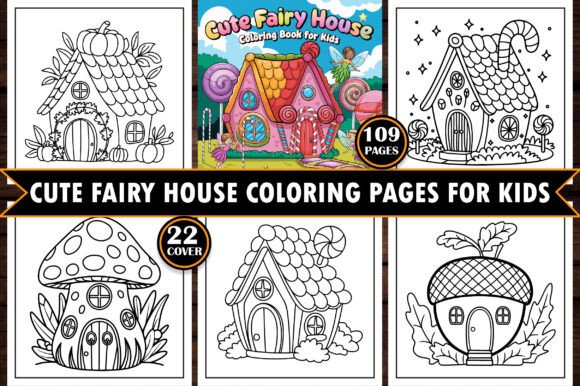
Cute Fairy House Coloring Pages for Kids
If you’ve ever watched a child’s face light up while coloring a tiny cottage with mushroom roofs and flower-lined paths—or seen an adult pause mid-day to trace the bold outline of a whimsical treehouse—you already know the quiet magic these pages hold. Cute Fairy House Coloring Pages for Kids isn’t just another coloring book. It’s a thoughtfully designed toolkit for calm, creativity, and connection—built around 109 large-print, high-contrast fairy house illustrations that invite color without demanding perfection.
Where This Coloring Book Fits Into Real Life
Think about your Tuesday afternoon: a homeschooling parent juggling screen time limits and sensory needs, a therapist setting up a low-pressure art activity for a child who struggles with transitions, or a grandparent looking for a shared, screen-free ritual with their grandchild. In each of those moments, Cute Fairy House Coloring Pages for Kids becomes more than paper and ink—it becomes scaffolding for presence.
Teachers use it during rainy-day indoor recess or as a quiet “choice time” option in early elementary classrooms. The bold lines and generous white space reduce visual overwhelm—especially helpful for kids with developing fine motor skills or attention differences. Counselors and occupational therapists often pull from this collection when supporting emotional regulation; the repetitive motion of coloring within clear boundaries offers grounding, while the fantasy theme invites imaginative storytelling without pressure to “get it right.”
Designed for Flexibility—Not Just One Use Case
This isn’t a rigid workbook with instructions or progress tracking. It’s intentionally open-ended. That means:
- Parents print one page before a long car ride—and have 20 minutes of focused calm instead of device requests.
- Educators project a fairy house design on a smartboard for collaborative group coloring, then ask students to describe what lives inside, sparking vocabulary-rich discussion.
- Small business owners (like craft studios or children’s bookshops) use the included PNG and JPG files to create custom printable kits—adding stickers, story prompts, or seasonal themes like “Winter Fairy Village” or “Spring Garden Hideaway.”
- KDP and Etsy sellers appreciate the full commercial license: 109 ready-to-upload pages, plus 22 cover backgrounds and vector EPS files—so they can publish physical or digital versions without redesigning a single line.
Why “Bold and Easy” Makes a Difference
The phrase “bold and easy” isn’t marketing fluff—it reflects real design decisions that impact usability. Each fairy house is drawn with thick, clean outlines (no delicate cross-hatching or ultra-thin details), printed at 8.5×8.5 inches so there’s plenty of room for small hands—or unsteady ones. At 300 dpi, every file holds crisp detail whether printed on home inkjet paper or professional matte stock.
This matters most when time or tolerance is limited. A child recovering from sensory overload doesn’t need to squint at faint lines. An adult managing anxiety doesn’t benefit from intricate mandalas when they’re seeking simplicity—not complexity. These pages meet users where they are: offering structure without rigidity, fantasy without confusion, and ease without sacrificing charm.
Who Benefits—and How They Use It Differently
A pediatric occupational therapist might select pages with symmetrical layouts to support bilateral coordination practice. A librarian curating a summer reading program could pair a fairy house coloring session with a short read-aloud about kindness or community—then ask kids to draw “what helps your fairy house feel safe.” A busy mom running a birthday party might print five copies of the same cottage page, hand out washable markers, and let kids decorate their own “fairy welcome sign” to hang on the wall.
Even adults outside traditional caregiving roles find value. Wedding planners sometimes adapt the designs into rustic-chic invitations or table numbers. Interior designers use the clean, modern silhouettes as mood board elements when pitching enchanted-garden-themed spaces. And yes—many buyers admit they bought it “for the kids,” then kept a few pages for themselves after realizing how soothing the rhythm of filling in a cobblestone path or a stained-glass window really is.
What to Consider Before You Download or Use It
Because it’s digital-first, you’ll need basic printing access—or a tablet with a stylus if you prefer digital coloring apps. While the PDF is print-ready, double-check your printer settings: selecting “fit to page” may shrink the 8.5×8.5″ layout unintentionally. For best results, choose “actual size” or “100% scale.”
The collection leans into cheerful, accessible fantasy—not dark folklore or highly detailed architectural realism. If you’re seeking gothic cottages or historically accurate Tudor designs, this isn’t the set. Likewise, while the lines are bold, they aren’t outlined in black marker-style thickness—so very young toddlers (under age 3) may still need guidance to stay within borders. Most users find it ideal for ages 4–10, with broad appeal for teens and adults seeking gentle creative reset.
Strengths That Show Up in Everyday Moments
Its biggest strength? Consistency with variety. All 109 pages share the same clean aesthetic—so a child isn’t startled by sudden shifts in line weight or style—but each house has its own personality: a teapot-shaped home nestled in lavender, a lantern-lit cabin built into a hillside, a spiral-staircase tower wrapped in ivy. That balance builds confidence (“I know how to color these”) while keeping interest alive (“Ooh—what’s *that* one?”).
The inclusion of multiple file formats—PDF, PNG, JPG, and EPS—means no dead ends. Need to isolate a single house for a classroom poster? Grab the PNG. Want to resize a design for a fabric transfer? Use the vector EPS. Planning to upload directly to KDP? The PDF is pre-formatted and bleed-free. Nothing requires extra software or design skill to start using.
A Resource That Grows With Its Users
One teacher shared how she started using Cute Fairy House Coloring Pages for Kids as a calming transition tool between math and literacy blocks—and ended up building an entire unit around it: students named their fairy houses, wrote short descriptions, measured doorways with nonstandard units, and even voted on which design should become the class “Reading Nook.” Another buyer used the cover backgrounds to design matching thank-you cards for her daughter’s birthday party guests—each card featuring a different fairy house and a handwritten note.
That’s the quiet power here: it doesn’t tell you how to use it. It gives you 109 starting points—and lets your real-world needs, relationships, and creativity decide where to go next.