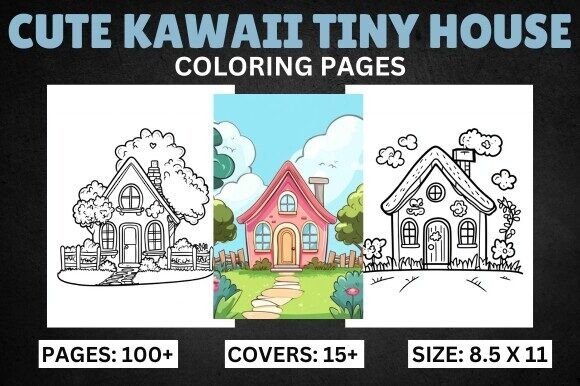
Cute Kawaii Tiny House Coloring Pages
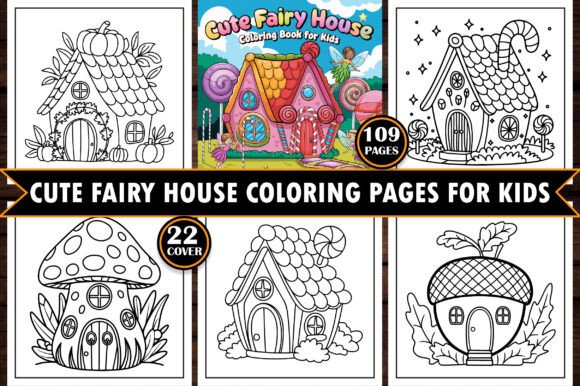
If you're building a high-content coloring book for Amazon KDP—or even designing themed journals, activity kits, or printable classroom resources—Cute Kawaii Tiny House Coloring Pages is more than just a bundle of line art. It’s a ready-to-deploy creative engine built for real-world publishing needs. With 100 high-resolution, black-and-white PNG pages (8.5” x 11”, 300 DPI), plus 15 professionally styled cover options, this interior download gives you flexibility without compromise—no tracing, no redrawing, no licensing headaches.
Where These Pages Fit in Real Publishing Workflows
Let’s talk about how creators actually use this asset—not as a theoretical “nice-to-have,” but as a working solution. For example, one indie publisher in Portland used the Cute Kawaii Tiny House Coloring Pages interior to launch a niche series: “Tiny Homes, Big Joy”—a calming coloring book aimed at adults downsizing or embracing minimalist living. She paired the kawaii-style houses with soft affirmations (“My space is enough,” “Small home, full heart”) and sold over 1,200 copies in three months. The kawaii aesthetic softened the sometimes-stressful topic of housing, making it emotionally accessible.
Meanwhile, a Montessori-aligned homeschooler in Austin integrated 20 of the pages into her seasonal activity bundle—grouping tiny houses with flower gardens, rainbows, and friendly animals to support fine motor development in kids aged 4–7. She didn’t need to edit the files; she simply dropped them into Canva, added gentle instructions (“Color the roof blue! Count the windows!”), and exported as a PDF workbook. No design degree required.
Who Benefits—and Why It’s Not Just for Kids
Yes, Cute Kawaii Tiny House Coloring Pages works beautifully for children’s books—but its appeal stretches much further. Adults seeking mindful decompression often respond strongly to kawaii’s gentle proportions, rounded edges, and whimsical details (think mushroom chimneys, smiling suns, and cat-shaped doorknobs). That’s why therapists, life coaches, and wellness educators are quietly adding these pages to client welcome packets or stress-management toolkits. One occupational therapist told us she prints select pages on cardstock, laminates them, and uses dry-erase markers during sessions with neurodivergent teens—a reusable, low-pressure way to explore spatial awareness and emotional regulation.
For men and women exploring tiny house lifestyles—even if just imaginatively—the illustrations serve as visual anchors. A builder in Asheville uses four of the designs in his free downloadable “Tiny House Mood Board Kit.” Clients color their ideal layout while discussing insulation types or loft placement. It’s not fluff—it’s engagement that leads to better-informed decisions.
Practical Considerations Before You Build Your Book
Before importing these pages into your KDP interior, consider your audience’s expectations. While all 100 pages are black-and-white and print-ready, some feature denser linework (ideal for adults who enjoy detail), while others lean into simplicity—clean outlines with generous white space, perfect for toddlers or beginners. Skim through the ZIP file first. Group pages by complexity level if you’re targeting multiple age ranges in one book.
You’ll also want to think about flow. Unlike generic mandala or floral bundles, these pages tell a subtle story: tiny houses in different settings (forest clearings, seaside cliffs, cloud-filled skies) and moods (cozy with steaming mugs, festive with lanterns, quiet at dusk). That narrative thread helps readers stay engaged across 50+ pages—no small thing when competing in a saturated KDP category.
And yes—these are fully KDP-tested. That means no transparency issues, no bleed-line surprises, and no unexpected gray halos around lines when converted to CMYK. You won’t waste time troubleshooting printer-ready output.
How Designers & Entrepreneurs Extend the Value
Smart users don’t stop at printing. One Etsy seller licenses the interior for digital-only use: she sells “Print-Your-Own Tiny House Coloring Journal” as an instant-download product, then upsells matching stickers and printable wall art inspired by the same motifs. Her customers love mixing and matching—coloring a house on page 12, then using the same window shape as a cut-out for a paper diorama.
Another creator layered select Cute Kawaii Tiny House Coloring Pages over watercolor backgrounds in Procreate, turned them into animated Instagram Reels showing “watch this house come alive,” and grew her account to 18K followers—all while promoting her physical KDP book in the bio.
Teachers use the pages for cross-curricular lessons: measuring window widths (math), naming architectural parts (vocabulary), imagining life in a tiny home (creative writing), or comparing real-world tiny houses vs. kawaii versions (critical thinking). One third-grade teacher printed two versions of the same house—one with labels (“loft,” “compost bin,” “rain barrel”), one blank—for a compare-and-contrast station.
What This Bundle Does Well—and Where It’s Honest About Boundaries
The strength of Cute Kawaii Tiny House Coloring Pages lies in its focused charm. It doesn’t try to be everything: no abstract mandalas, no hyper-realistic florals, no complex geometric patterns. Instead, it delivers consistent tone, scalable resolution, and immediate usability. If you need versatility across audiences—from toddlers to retirees—you’ll find it here. If you need ultra-modern, industrial, or photorealistic interiors? This isn’t that bundle. And that’s okay.
Likewise, while the 15 cover designs offer strong starting points (pastel palettes, clean typography, subtle texture overlays), they’re meant to be customized—not treated as final. Most successful sellers tweak at least one element: swapping fonts, adjusting title hierarchy, or adding a short subtitle like “Stress-Relieving Tiny Home Scenes for Grown-Ups.”
Finally, remember: these are PNGs, not editable vector files. So if you need to resize a single window or reposition a cloud, you’ll work within raster constraints. But for standard book layouts? They’re perfectly sized, sharply rendered, and production-ready.
Real Use Cases, Not Just Keywords
- A retirement community activity coordinator prints 10 pages weekly as part of “Creative Mornings,” pairing coloring with light conversation about home memories.
- An interior designer includes three pages in her free “Design Your Dream Space” lead magnet—prospects color their ideal tiny kitchen, then book consultations to bring it to life.
- A bilingual educator adapts five pages into Spanish/English dual-text versions, supporting language learners while reinforcing spatial vocabulary (“la puerta,” “el tejado,” “la ventana”).
- A mental health nonprofit distributes printed sets to shelters and transitional housing programs—giving residents a tactile, hopeful way to imagine safety and belonging.
None of those uses require special permissions, extra software, or design expertise. Just clarity of purpose—and the right starting material. That’s what makes Cute Kawaii Tiny House Coloring Pages more than a download. It’s a quietly powerful tool for connection, creativity, and calm—ready when you are.