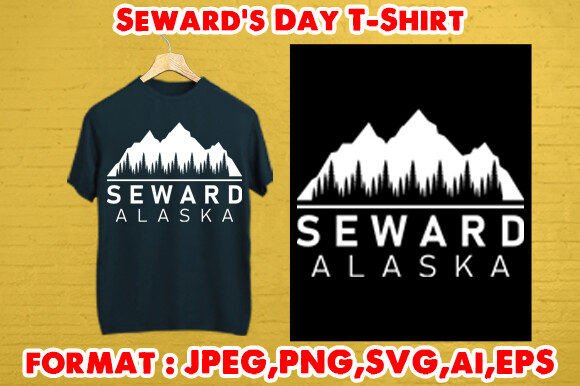
Seward’s Day T-Shirt: A Practical Resource for Print-on-Demand and Creative Businesses
A Seward’s Day T-Shirt is more than a seasonal design—it’s a versatile, ready-to-deploy digital asset tailored for creators operating in print-on-demand (POD) and Kindle Direct Publishing (KDP) ecosystems. Unlike generic holiday-themed graphics, this resource centers on Seward’s Day—a recognized Alaska state holiday commemorating the 1867 Alaska Purchase—and delivers it as a professionally prepared, multi-format design package. Its value lies not in novelty alone, but in functional flexibility: high-resolution files compatible across apparel, accessories, home goods, and publishing formats.
What Makes This Seward’s Day T-Shirt Distinct?
Most holiday-themed designs are offered as single-format JPEGs or low-res PNGs—adequate for basic t-shirt mockups but limiting for scaling across product types. In contrast, a well-structured Seward’s Day T-Shirt package includes layered, editable source files: PNG (transparent background, ideal for web previews), JPEG (optimized for fast loading and KDP interior thumbnails), EPS and AI (vector-based, infinitely scalable for large-format wall art or embroidery digitization), SVG (lightweight and responsive for web integration), and sometimes PDF (for print-ready layouts). This breadth supports consistent branding whether applied to a crewneck sweatshirt, kids’ onesie, laptop case, or coloring book page.
The design itself typically balances historical reference with visual accessibility—featuring clean typography, subtle Alaskan motifs (e.g., snow-capped peaks, sled dogs, or the Alaska flag), and color palettes that reproduce well on both light and dark garments. It avoids overcomplication: no photorealistic gradients or fine halftones that degrade when scaled down for pins or magnets. Instead, it prioritizes clarity at multiple sizes—from 1.5-inch enamel pins to 48-inch tapestries.
How It Fits Within Broader Design Ecosystems
When evaluating creative assets for POD or KDP, designers often face a tradeoff between speed and control. Stock design marketplaces offer quick downloads but rarely include full vector suites or licensing clarity for commercial reuse. Custom illustration commissions deliver exclusivity and precision—but require time, budget, and revision cycles. A Seward’s Day T-Shirt occupies a middle ground: pre-vetted for technical readiness, commercially licensed for resale, and built for immediate deployment without design overhead.
Compare this to generic “Alaska-themed” bundles: many contain repetitive silhouettes or clichéd slogans (“Born in Alaska”) with limited file variety. Others focus exclusively on tourism angles—not state-specific observances like Seward’s Day. That specificity matters. For sellers targeting Alaskan residents, educators, history enthusiasts, or local gift shops, authenticity resonates more than broad appeal. It also reduces competition: fewer sellers optimize for this niche compared to ubiquitous “4th of July” or “Christmas” collections.
Practical Use Cases Across Product Categories
Each file format serves distinct production needs:
- JPEG & PNG: Best for KDP interior pages (coloring books, activity journals), social media ads, and initial product mockups. High-quality JPEGs compress well without visible artifacts; PNGs preserve transparency for layered designs on tote bags or phone cases.
- EPS & AI: Essential for professional screen printing, vinyl cutting (magnets, stickers), or large-scale wall art. These vector formats retain crisp edges regardless of size—critical when resizing from a 10-inch notebook cover to a 36-inch tapestry.
- SVG: Ideal for web-based customization tools (e.g., Shopify apps that let buyers adjust text or colors), Cricut/Silhouette projects, or animated product previews.
This versatility translates directly to product expansion. A single Seward’s Day T-Shirt design can appear on:
- Apparel: Crewneck sweatshirts (cotton blend), long sleeve tees (ring-spun fabric), baseball tees (tri-blend), tank tops (athletic cut), kids’ hoodies (fleece-lined), and infant onesies (soft cotton).
- Accessories: iPhone cases (matte or glossy finish), laptop sleeves (13"–16"), enamel pins (25mm diameter), and fridge magnets (flexible vinyl).
- Home & Lifestyle: Canvas wall art (24"x36"), linen throw pillows (zippered inserts), jute tote bags (spot-color print), and woven tapestries (for dorm rooms or offices).
- Publications: Interior coloring pages (8.5"x11", grayscale line art), themed notebooks (cover + interior accents), and educational activity books (matching games, map outlines).
Tradeoffs and Realistic Limitations
No single design asset solves every need. A Seward’s Day T-Shirt excels in consistency and efficiency—but has boundaries worth acknowledging.
First, while vector files support scaling, they don’t automatically adapt to complex garment textures. A design optimized for smooth cotton may require minor tweaks for fleece-lined hoodies or textured canvas topper bags. Second, color fidelity varies across substrates: what reads as deep navy on a white tee may shift toward slate gray on heather grey fabric or matte black phone cases. Third, KDP interior files must meet strict DPI and bleed requirements—some packages include pre-formatted PDFs for coloring books; others expect users to adjust margins manually.
Also consider audience alignment. Seward’s Day is observed primarily in Alaska—so national campaigns may see lower engagement than regionally targeted efforts. Sellers outside Alaska should pair this design with complementary themes (e.g., “Alaska Statehood Day,” “Denali National Park”) to build broader relevance. And while the design is historically grounded, it’s not academic: it doesn’t include citations, timelines, or archival images—making it unsuitable for formal classroom materials unless supplemented.
When to Choose This Over Alternatives
A Seward’s Day T-Shirt is most valuable when you prioritize:
- Speed-to-market: Launching before March 30 (Seward’s Day) requires assets ready for upload—no waiting for revisions or conversions.
- Multi-product consistency: Maintaining cohesive visuals across apparel, accessories, and paper goods without redesigning for each medium.
- Regional authenticity: Serving Alaskan customers, schools, museums, or tourism operators who value accurate cultural representation over generic symbolism.
- Scalable licensing: Reselling via POD platforms (Redbubble, Teespring, Printful) or KDP without legal ambiguity around usage rights.
It’s less optimal if you need:
- Exclusive ownership (most Seward’s Day T-Shirt packages are non-exclusive);
- Animated or interactive versions (e.g., AR-enabled coloring pages);
- Localized translations (e.g., bilingual English–Iñupiaq text); or
- Photographic realism (e.g., vintage document scans or period portraits).
Making an Informed Decision
Before acquiring a Seward’s Day T-Shirt, review the file list carefully. Confirm inclusion of both raster (JPEG/PNG) and vector (EPS/AI/SVG) formats—not just one or two. Check resolution specs: PNGs should be ≥3000px wide at 300 DPI; EPS/AI files should contain editable layers and ungrouped elements. Verify commercial license scope—does it cover physical products, digital downloads, and resale? Does it permit use on third-party platforms like Etsy or Amazon?
Test compatibility early. Upload the SVG to your preferred POD dashboard to confirm rendering accuracy. Import the PNG into Canva or Adobe Express to preview how it scales on a mockup of a kids’ long sleeve tee. If using it for KDP coloring books, open the JPEG in Photoshop and verify line weight consistency at 100% zoom—thin strokes may vanish when printed small.
Finally, assess fit within your existing catalog. Does this design complement—not duplicate—your current Alaska-themed offerings? Does its tone align with your brand voice (e.g., respectful and educational vs. playful and cartoonish)? Alignment matters more than volume: one well-integrated Seward’s Day T-Shirt asset often outperforms five mismatched alternatives.